
 The Quiet Shift: How American Businesses Are Staffing Back Offices in the Philippines
A gradual but meaningful shift is reshaping how American businesses manage their back-office operations. Instead of relying solely on domestic hiring, many are extending their teams by adding offshore staff in the Philippines.
This is not a short-term trend or a reaction to temporary pressures. It reflects a broader operational decision. Businesses are looking for ways to increase capacity, maintain control, and avoid the complexity that often comes with scaling locally.
Back-office functions such as customer support, billing, administration, and accounting remain essential. The challenge is not their importance, but how to scale them efficiently without placing additional strain on internal systems.
Related: Top-Rated VA Companies in the Philippines.
Table of Contents
Why Businesses Are Reconsidering Back-Office Staffing
Rising Cost of Local Hiring
For many US companies, the cost of hiring locally has increased significantly across support roles. Expenses extend beyond salaries to include benefits, infrastructure, and administrative overhead.
As teams grow, these costs compound quickly, placing pressure on margins and limiting flexibility.
Growing Demand for Operational Support
As businesses expand, so does the need for consistent back-office support. This includes:
- Customer service and support
- Billing and collections
- Administrative coordination
- Data management and reporting
- Accounting and bookkeeping
These functions are critical for daily operations, yet scaling them locally often introduces delays and inefficiencies.
The Need to Maintain Simplicity
Growth often brings operational complexity. More hires can mean more systems, more coordination, and more internal management.
Many businesses are now prioritizing models that allow them to expand support functions without disrupting existing workflows.
Why the Philippines Has Become a Key Location
The Philippines continues to be a preferred destination for offshore staffing, particularly for back-office roles.
Strong Communication Capabilities
High levels of English proficiency support clear communication, especially in customer-facing and administrative roles.
Workforce Alignment
Filipino professionals are widely recognized for their adaptability and familiarity with Western business practices, which helps reduce friction when integrating into existing teams.
Depth of Talent
Businesses can access skilled professionals across multiple functions, including:
- Customer support
- Operations support
- Billing and collections
- Administrative roles
- Accounting and bookkeeping
This allows companies to align talent directly with operational needs.
Moving Beyond Freelancers to Structured Staffing
One of the more notable changes in offshore staffing is the move away from freelance-based models toward dedicated staff integration.
Freelancers remain useful for short-term or project-based work. However, many businesses now prioritize consistency, reliability, and long-term alignment.
Dedicated offshore staff offer a different structure:
- They work exclusively within one business
- They follow internal systems and workflows
- They integrate into daily operations
- They provide stable, ongoing output
This creates a more cohesive and scalable approach compared to fragmented freelance arrangements.
How VirtualStaff.ph Supports This Shift
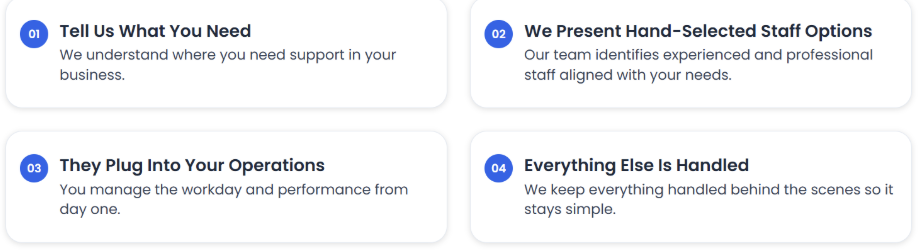
Platforms like VirtualStaff.ph reflect this evolution by offering a structured approach to offshore staffing.
A Structured Offshore Staffing Model
VirtualStaff.ph provides dedicated offshore support staff in the Philippines who integrate directly into a company’s operations. The business manages the workday, while the platform handles the surrounding staffing structure.
This model emphasizes integration, control, and operational continuity rather than outsourcing tasks externally.
Predictable Monthly Cost
Businesses pay a single, consistent monthly amount per staff member, with no hidden fees or complex pricing layers.
This simplifies budgeting and removes the need to manage multiple service providers.
No Entity Setup Required
Companies are not required to establish a legal entity in the Philippines. The platform manages employment and compliance, allowing businesses to focus on operations.
Minimal Operational Disruption
The model is designed to fit into existing workflows. Businesses do not need to adopt new systems or restructure internal processes. Instead, they extend their teams with additional capacity.
A Practical Approach to Scaling Teams
One of the defining characteristics of this model is its flexibility.
Most businesses begin with a small number of staff and expand gradually. This allows them to:
- Evaluate how offshore staffing fits into their operations
- Measure improvements in efficiency
- Scale at a controlled pace
Over time, companies often build larger teams, sometimes growing from a few staff members to dozens, depending on operational needs.
Common Roles Being Offshored
Back-office functions are particularly well-suited to offshore staffing because they do not require a physical presence.
Common roles include:
- Administrative assistants
- Customer support representatives
- Billing and collections staff
- Bookkeepers and accounting support
- Operations coordinators
By shifting these functions offshore, businesses can focus internal resources on higher-level priorities.
Reducing Complexity While Increasing Capacity

A key reason businesses adopt this approach is not just cost control, but operational clarity.
The goal is to increase output without introducing additional complexity. This aligns with a broader shift in how companies think about staffing:
- More capacity without heavier payroll structures
- More support without additional management layers
- More output without disrupting existing systems
This reflects a move toward structured staffing models that prioritize integration and control over traditional outsourcing approaches.
Conclusion
The shift toward offshore back-office staffing is not abrupt or highly visible. Instead, it is a steady operational adjustment being made by businesses seeking practical ways to grow.
Adding offshore staff in the Philippines has become a consistent strategy for increasing capacity while maintaining control over daily operations.
Platforms like VirtualStaff.ph illustrate how this model is evolving. By focusing on structured integration, predictable costs, and operational simplicity, they offer businesses a way to expand without overcomplicating their systems.
Rather than replacing traditional teams, offshore staffing is becoming an extension of them. For many companies, this quiet shift is not just about staffing. It represents a more controlled and sustainable way to scale.